
Mr Modi might have questions to ask himself on the most formidable strategic challenge before India that he inherited from the United Progressive Alliance: The triangulation between China and Pakistan. The failure to break out of it, or even loosen it a bit, is something to reflect on, notes Shekhar Gupta.

'During Congress rule, the government used to get both the fishermen and the boats released whenever the Sri Lankan navy apprehended them.' 'Under BJP rule, only the fishermen are being released.'
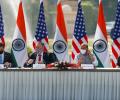
Henry Kissinger once said, 'It may be dangerous to be America's enemy, but to be America's friend is fatal.' India will have to wait and see, observes Rajeev Srinivasan.

'The Indian government evacuated its citizens from the clutches of the Taliban and Covid-hit Wuhan, so I am not worried.'

Some of our leaders were busybusy over the weekend.


Whether it is Sri Lanka, Maldives, or Nepal, quietly but steadily, India has been reclaiming some of the ground it had lost to China, observes Aditi Phadnis.

'If the Chinese were keen to mend fences with India, they would merely have to withdraw their troops in Eastern Ladakh.' 'They have not done so and they have not said that they will do so.'

Chinese Foreign Minister Qin Gang will travel to India to attend the meeting of G20 foreign ministers on March 2, during which he is expected to hold his first bilateral meeting with External Affairs Minister S Jaishankar.

'I am not minimising either the seriousness or the complex nature of the current situation.' 'Naturally, we have to do what it takes to secure our borders.' 'We are talking to the Chinese, both through military channels and diplomatic ones.'
'In fact, they work in tandem.' 'When it comes to finding a solution, this must be predicated on honouring all agreements and understandings.' 'And not attempting to alter the status quo unilaterally.'

'Although perhaps not with a greater majority, and maybe even a slightly reduced majority in the Lok Sabha.'
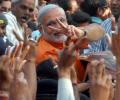
'Indians go to vote next week -- the world's oldest democracy should both celebrate and perhaps analyse this event and its implications.' Dr S Jaishankar, India's ambassador to the US, offers prescriptions for India-US ties.
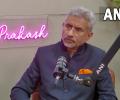
Jaishankar said his father was also a very upright person, "may be that caused the problem, I don't know".
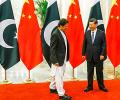
If and when India and Pakistan bilateral talks take place any issues concerning Jammu and Kashmir will not be on the table. Any future talks with Pakistan will be only about PoK, tactically or otherwise.
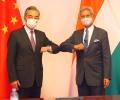
'We've never really been in the situation of having a difficult time with the Chinese and an increasingly difficult time with the Russians along with a relationship with the Americans which is important.'
"The 21st century peacekeeping must be anchored in a strong ecosystem of technology and innovation that can facilitate UN peacekeeping operations in implementing their mandates in complex environments," India's external affairs minister S Jaishankar said

India on Friday launched a no-holds-barred attack on Pakistan Foreign Minister Bilawal Bhutto-Zardari for his 'uncivilised' outburst against Prime Minister Narendra Modi and said the comments were a 'new low' even for that country.

China remains the elephant in the room and has to be tamed, which the United States alone is unable to do and therefore calls allies to come on board.

Heading G20 will give India a foreign affairs year like it has never had in history. You can trust Narendra Modi to exploit this to India's benefit. And, of course, to his own in his election year, explains Shekhar Gupta.
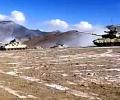
Once the tanks roll back, a zero-based assessment of future equations with China is necessary. Given the conflict situations that China is imposing on India time and again, the red, amber and green lines of interactions with China need to be laid down and communicated in no uncertain terms, asserts Srikanth Kondapalli, the leading China expert.
Prime Minister Modi has entrusted Amit Shah with the task of coordinating all the agencies with their power to monitor movement and phone calls, says R Rajagopalan.
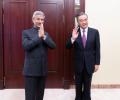
External affairs minister S Jaishankar has told his Chinese counterpart Wang Yi that the two sides should work for an early resolution of the remaining issues along the LAC in eastern Ladakh to restore peace and tranquility in the border areas as this has been an essential basis for progress in Sino-India ties.
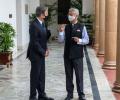
We do not know, because there has been no discussion, no transparency and most likely no real thinking on this matter at our end, observes Aakar Patel.

Indian Ambassador to the United States Dr S Jaishankar told Rediff.com's Aziz Haniffa that it was "a very nice meeting and President Barack Obama was extremely cordial."
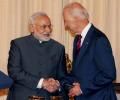
US-India defence cooperation must not adversely affect the India-Russia interface, which has its own strategic meaning and content, asserts Vice Admiral Premvir Das (retd).
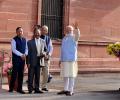
'Modi personally provides the higher direction of the ministry and the minister then works with bureaucrats on implementation,' points out Aakar Patel.

'Analysts see BECA as a 'force multiplier' for India.' 'But China too is known to have such capabilities.' 'The military gap with China will continue to remain a fact of life, BECA notwithstanding,' argues Ambassador M K Bhadrakumar

With the situation in Ladakh tense and no resolution in sight the trigger to take the India-US relationship to a transformational one is already there, observes Lieutenant General Syed Ata Hasnain (retd).

India-China relations have always attracted Parliament's attention and there have always been useful and productive and constructive discussions how to engage with China, notes Rup Narayan Das.

'This is a historic juncture when the US is in great need of an alliance with India to strengthen its hands in the fierce struggle with China in the Asian theatre,' points out Ambassador M K Bhadrakumar.
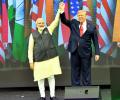
'For Trump, this maddening extravaganza will play out well in his election campaign, showing himself off as a hugely popular world leader,' points out Ambassador M K Bhadrakumar.

'India has to prepare for future warfare where kinetic use of force at the border will be limited. War will take place in the realms beyond the border.'
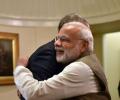
The camaraderie between Modi and Obama has taken the India-US relationship to unprecedented and transformative levels.
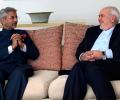
'Tehran,' Foreign Minister Zarif said, 'had expected the Modi government to be "more resilient" in the face of Washington's bullying,' notes Ambassador M K Bhadrakumar.

As the pandemic unfolded, the India-China relationship has come under severe stress. To restore normalcy, agreements between the two countries must be respected scrupulously in their entirety. Where the Line of Actual Control is concerned, any attempt to unilaterally change the status quo is unacceptable, declares External Affairs Minister Dr Subrahmanyam Jaishankar.

India's soft power diplomacy came into play during this cataclysm affecting the world as the pandemic defies barriers and borders, notes Rup Narayan Das.
'It is advisable for Indian interlocutors to follow the Chinese tactic of repeating the Indian position, both for the record and to test the Chinese negotiator's resolve and intentions.' A riveting excerpt from former foreign secretary Vijay Gokhale's The Long Game: How the Chinese Negotiate With India.

'Even as discord over US-India trade and commerce colours diplomatic relations, defence relations between the two countries remain on a firm footing,' points out Ajai Shukla.
A wise politician would disarm his critics, try to take them along, co-opt them, or, at least, take the criticism in his stride. Developing a thick skin ought to be an essential part of any politician's toolkit, notes Virendra Kapoor.

In a sudden development, S Jaishankar, India's Ambassador to the United States, was on Wednesday night appointed Foreign Secretary, replacing Sujatha Singh whose tenure has been abruptly 'curtailed" by nearly 8 months.
 © 2026 Rediff.com - Advertise with us - Disclaimer - Privacy Policy - Sitemap - Feedback - About us - Terms of use - Grievances